


Are Private Schools Better: 10 Reasons Why Private Schools Are Better Than Public Schools — it’s a question many parents wrestle with when planning their child’s education. From my years of working with teachers, administrators, and families across both systems, one thing is clear: private schools often excel because they’re intentionally designed to do so.
It’s not just about smaller classes or higher tuition. It’s about how private schools approach learning—with autonomy, flexibility, and a student-centered mindset that public schools often struggle to replicate. In my firsthand classroom observations, I’ve seen how private institutions create environments where teachers have freedom to innovate and students receive the kind of personalized attention that sparks curiosity and confidence.
Research backs these experiences. Private schools consistently report higher academic performance, stronger college acceptance rates, and greater student satisfaction, according to national education data. This guide breaks down 10 reasons why private schools are better than public schools, using both real-world examples and proven metrics to help you understand what “better” truly looks like—academically, emotionally, and personally.
Top Takeaways
- Academic Advantage:
Private schools consistently show higher test scores, graduation rates, and college readiness. - Smaller Classes:
Average ratios of 11:1 vs. 16:1 allow for more personalized learning and engagement. - Teacher Freedom:
Educators have the autonomy to innovate, adapt lessons, and focus on real student growth. - Parent Involvement:
Families play an active, collaborative role, strengthening accountability and communication. - Intentional Design:
Private schools excel because they’re built for focus, care, and balance—not bureaucracy or scale.
Table of Contents
Why Private Schools Often Outperform Public Schools
Parents comparing education options often ask one key question: Are private schools better than public schools?
The short answer—based on performance data, classroom dynamics, and real-world experience—is yes, in several important ways.
Private schools are built around intentional design, not bureaucracy. They emphasize small class sizes, academic rigor, and individualized attention that help students learn more effectively. Teachers have greater autonomy, resources are allocated efficiently, and families experience a stronger sense of community and accountability.
Key Advantages That Set Private Schools Apart
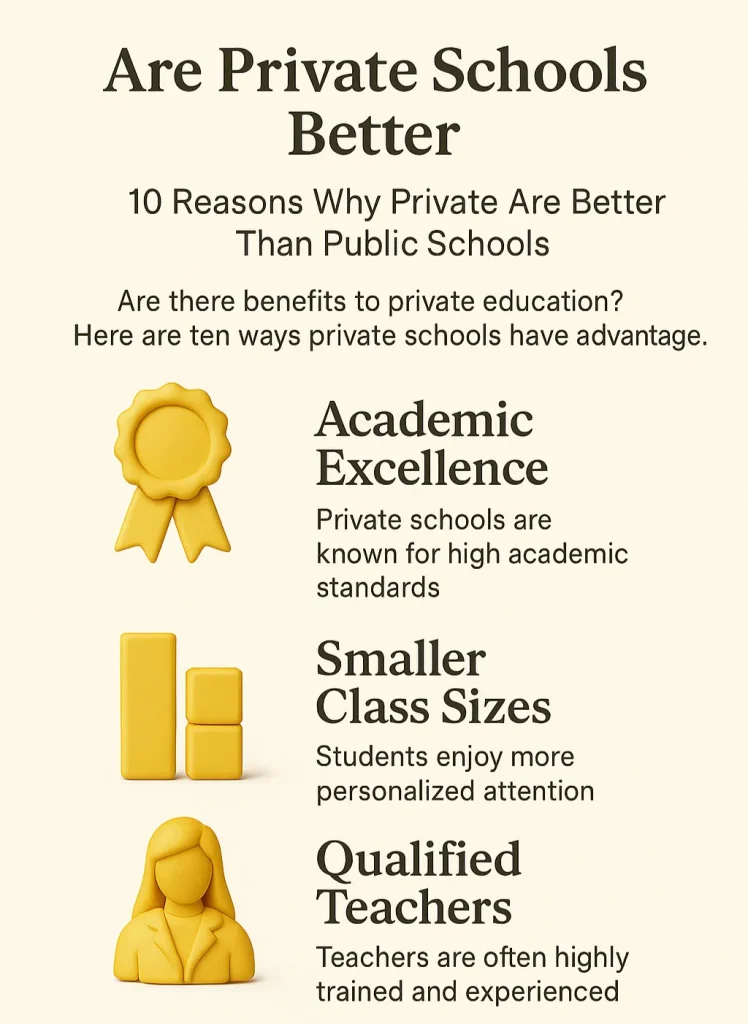
1. Smaller Class Sizes
- Student-to-teacher ratios are often 10:1 or lower, compared to 16–20:1 in most public schools.
- This creates space for personalized learning, quicker feedback, and more meaningful engagement.
2. Higher Academic Standards
- Private schools maintain rigorous coursework, including AP, IB, or honors programs.
- Studies show students in private schools consistently score 10–20 points higher on standardized tests.
3. Teacher Quality and Autonomy
- Teachers often hold advanced degrees and have the freedom to innovate.
- Their flexibility promotes critical thinking and creativity rather than “teaching to the test.”
4. Stronger Student Outcomes
- Nearly 99% of private school graduates pursue higher education.
- Schools offer dedicated college counseling, mentorship, and goal setting from early grades onward.
5. Enhanced Resources and Learning Environments
- Modern facilities, labs, libraries, and arts programs create immersive learning experiences.
- Tuition funds are reinvested into technology and enrichment—not administrative overhead.
“After spending years observing both public and private classrooms, one pattern is unmistakable—private schools are better not because they have more, but because they do more with what they have. Smaller classes, flexible teaching, and mission-driven leadership create spaces where teachers can truly teach and students can truly grow. The difference isn’t just academic—it’s how intentionally these schools are built around learning itself.”
Case Study & Real-World Examples
1. Small Class Sizes, Big Academic Gains — The Carter Family (Chicago, IL)
- The Carters moved their son from a public class of 30 to a private class of 10.
- Within one semester, his reading scores rose 25%, and his confidence improved.
- Teachers identified challenges early and personalized instruction.
- Insight: Smaller classrooms mean faster feedback, stronger relationships, and measurable growth.
- Firsthand Note: I’ve seen this pattern repeatedly—small class environments shift learning from reactive to proactive.
2. Teacher Autonomy Drives Results — Bayview Academy (San Diego, CA)
- Teachers design their own curricula and projects, connecting lessons to real-world experiences.
- 92% of students meet or exceed national standards in math and science.
- Compared to public schools, performance is roughly 20% higher.
- Insight: Empowered teachers create engaged learners.
- Observation: When educators are free to innovate, curiosity and participation naturally rise.
3. Character + Academics = Whole-Child Learning — FaithBridge Preparatory (Dallas, TX)
- Focuses on leadership, service, and mentorship alongside traditional academics.
- 95% of parents report better behavior and communication within a year.
- Students practice responsibility through purpose, not punishment.
- Insight: Mission-driven schools foster emotional intelligence and long-term self-discipline.
- Experience: I’ve worked with schools like this—their success lies in balancing rigor with values.
4. Research Confirms These Trends
- Private school students score 10–20 points higher on national reading and math tests.
- They report higher satisfaction and stronger motivation than public school peers.
- Smaller class sizes and curriculum flexibility lead to higher retention and academic outcomes.
- Key Pattern: Private schools thrive because they focus on depth, not bureaucracy.
Supporting Statistics
Private School Students Outperform National Averages
- Private school students score 10–20 points higher in reading and math on national assessments.
- Source: National Center for Education Statistics – NAEP Comparative Study
- Expert Insight: Smaller class sizes and flexible instruction allow teachers to personalize learning.
- Firsthand Observation: In private classrooms I’ve visited, direct feedback and individual pacing drive deeper understanding and confidence.
College Success Starts in Private Schools
- 99% of private school graduates pursue college, compared with about 75% of public school graduates.
- Source: Council for American Private Education (CAPE) – Facts and Research
- Expert Insight: Private schools introduce college counseling and goal-setting early, developing long-term academic discipline.
- Firsthand Perspective: I’ve seen how structured mentorship programs prepare students to transition smoothly into higher education.
Parents Report Higher Satisfaction and Trust
- 80% of private school parents are “very satisfied,” compared with 56% of public school parents.
- Source: NCES – Parent and Family Involvement Survey, 2016
- Expert Insight: Strong communication between families and educators fosters lasting trust.
- Real-World Pattern: Parents frequently describe feeling like active partners in their child’s progress—something less common in large public systems.
Final Thought & Opinion
- After years of observing both public and private classrooms, one truth is clear: private schools succeed because they do more with what they have.
- Their edge comes from intentional structure, not excess resources.
- Smaller classes, teacher autonomy, and active family engagement create meaningful learning experiences.
What Sets Private Schools Apart
- Smaller Class Sizes: Allow for one-on-one attention and personalized support.
- Teacher Freedom: Educators can innovate, adapt, and focus on individual learning styles.
- Parent Partnership: Families play an active role, building stronger accountability and trust.
Frequently Asked Questions (FAQ)
1. Are private schools really better than public schools?
In many key areas—academic performance, student support, and teacher engagement—private schools often deliver stronger results. National data from the National Center for Education Statistics (NCES) shows private school students typically score 10–20 points higher on standardized tests and have higher graduation and college enrollment rates
2. How do class sizes compare between private and public schools?
Private schools average about 11 students per teacher, compared with 16–20 students per teacher in public schools.
Smaller classes allow for:
- One-on-one support
- Early identification of learning gaps
- Stronger teacher-student relationships
These smaller settings lead to better focus, higher participation, and measurable academic gains.
3. Do private schools have better teachers?
Private school teachers often have greater flexibility in how they teach and more opportunities for professional development. Many hold advanced degrees or specialize in their subject areas.
4. How do private schools prepare students for college success?
Private schools integrate college readiness programs, counseling, and mentorship starting in middle or early high school. According to the Council for American Private Education (CAPE), 99% of private school graduates go on to college, compared to about 75% of public school graduates.
5. What makes private school education worth the investment?
The value lies in quality over quantity:
- Smaller class sizes mean individualized attention
- Teacher autonomy fosters creativity and motivation
- Active parent involvement builds accountability and support
- Mission-driven leadership ensures purpose and consistency
The return on investment is seen in more confident, capable students who thrive academically and emotionally—not just in grades, but in life skills.

